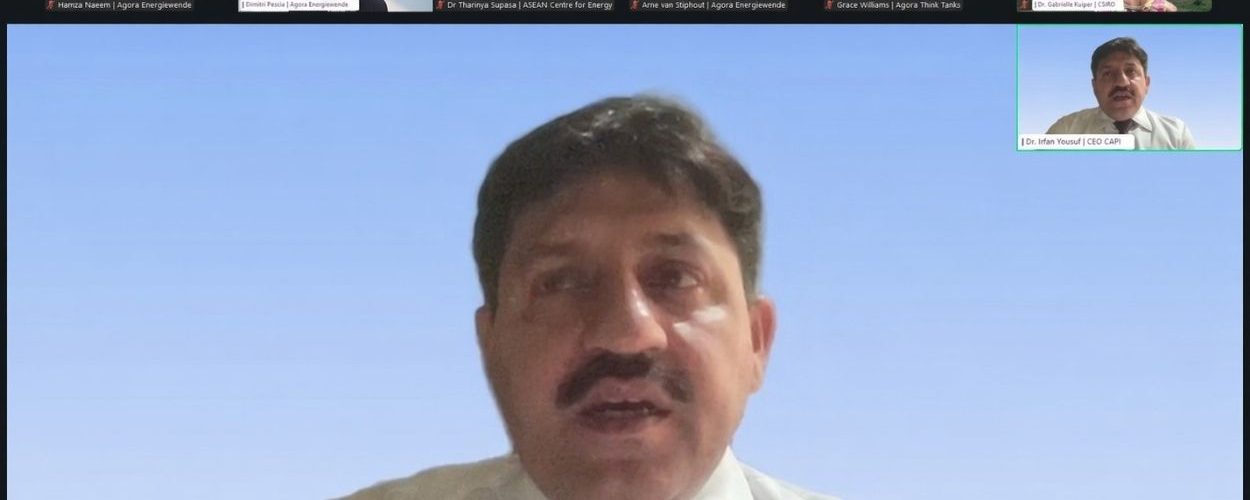
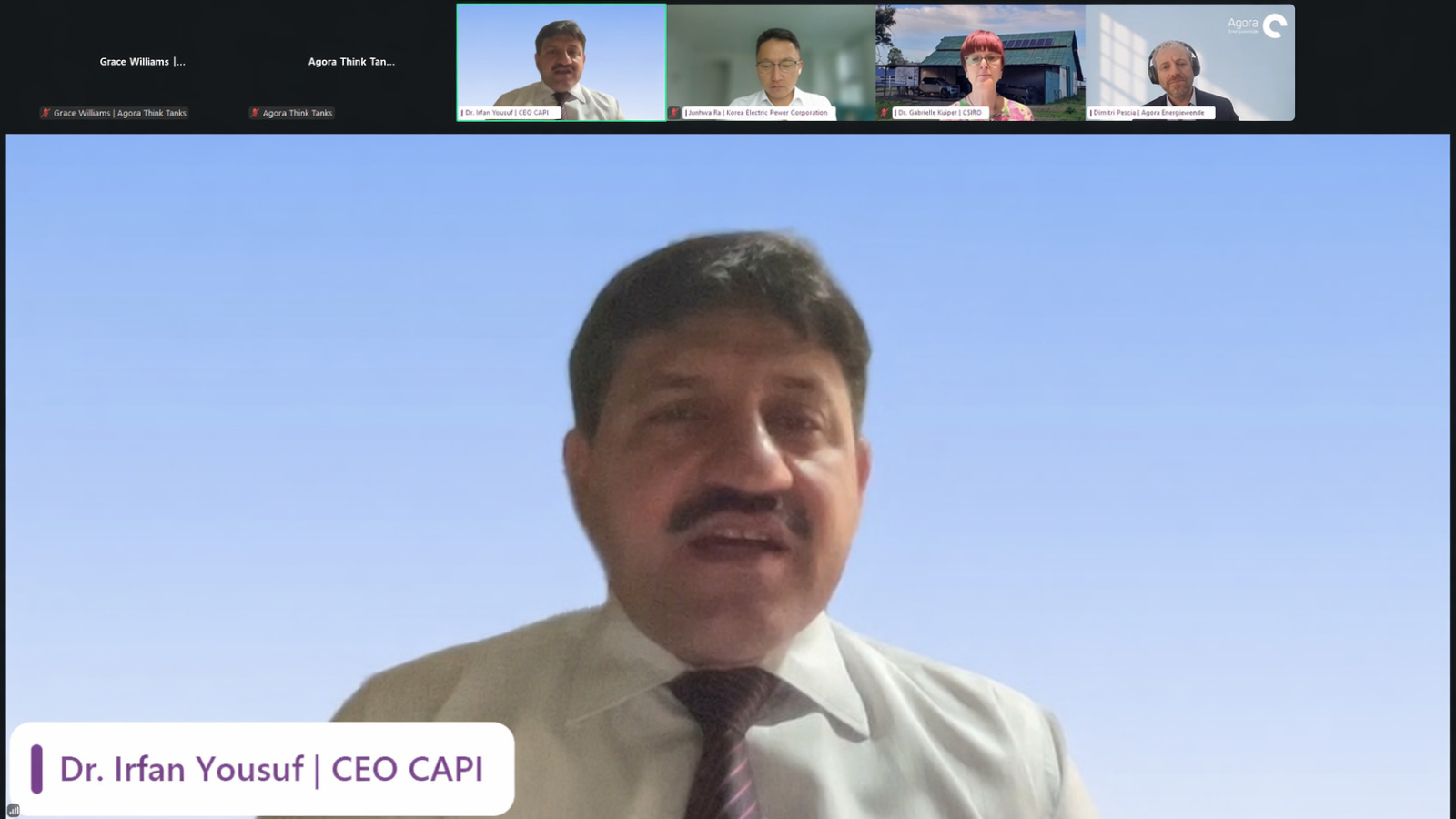
On 23 April 2026, Dr. Irfan Yousuf, CEO of Climate Action and Policy Initiative (CAPI), joined a distinguished international panel at the Agora Energiewende webinar, “Building the Electricity Distribution Grid Southeast Asia Needs.” The session brought together policymakers, regulators, utilities, and development partners working to translate clean energy ambitions into concrete regulatory and investment action.
Moderated by Dimitri Pescia, Director of Power System Transformation at Agora Energiewende, the panel featured perspectives from Pakistan, Korea, and Australia, alongside insights from the ASEAN Centre for Energy. The discussion explored how distribution grids can move from being a bottleneck to becoming the foundation of resilient, affordable, and clean power systems.
Pakistan’s Solar Story: A Cautionary and Instructive Case
Speaking on behalf of CAPI, Dr. Yousuf addressed two central questions posed by the moderator:
1. Lessons from Pakistan’s solar rush driven by government policy and incentives
Dr. Yousuf outlined how a combination of generous net-metering regimes, tariff-based incentives, falling panel prices, and rising grid electricity costs triggered an unprecedented surge in rooftop and distributed solar uptake across Pakistan. While this signalled a remarkable energy transition from below, it also exposed deep structural weaknesses:
- Distribution utilities were not technically or commercially prepared for the scale of reverse power flows.
- Planning, forecasting, and interconnection processes lagged behind on-the-ground realities.
- Cross-subsidies and fixed costs began shifting disproportionately onto non-solar consumers, raising serious equity concerns.
- The pace of digitalisation, metering upgrades, and grid modernisation could not keep up with consumer-led deployment.
2. Recommendations and a way forward for other countries
Drawing on Pakistan’s experience, Dr. Yousuf offered several forward-looking recommendations:
- Anticipate, don’t react: Build distribution-level scenarios into national energy planning well before incentive regimes are launched.
- Design tariffs for fairness and sustainability: Periodically review net-metering and feed-in structures so that grid cost recovery remains equitable across all consumer classes.
- Invest early in grid visibility: Prioritise smart meters, SCADA upgrades, and distribution management systems before distributed energy resources (DERs) saturate the network.
- Enable, then integrate, distributed flexibility: Create regulatory space for aggregators, storage, and demand response to support the grid rather than stress it.
- Strengthen the DISCO–TSO interface: Coordination between distribution and transmission operators is no longer optional — it is the backbone of a reliable clean-energy system.
- Protect the just transition: Ensure rural, low-income, and vulnerable consumers are not left bearing the costs of a transition they cannot yet access.
A Shared Global Conversation
The exchange reflected CAPI’s core mission — bridging evidence, policy, and implementation to support climate and energy transitions in Pakistan and beyond. As Southeast Asia, South Asia, and other emerging economies navigate similar crossroads, Pakistan’s experience offers both a warning and a roadmap.
CAPI remains committed to contributing to these global dialogues and to strengthening the regulatory, institutional, and investment foundations needed for a clean, affordable, and resilient power future.
The webinar recording will be made available on the Agora Energiewende website. The accompanying policy brief, “Priorities for Distribution Grid Modernisation,” was published on 21 April 2026.